
CPL (Cost per Lead) is the average marketing cost you pay to acquire one lead — a form submission, demo request, gated download, or trial signup. Calculated as total spend ÷ number of leads, it is the headline efficiency metric for any funnel that sells through pipeline rather than a one-click checkout. CPL is the close cousin of CPA: same arithmetic, different denominator. CPA counts customers (or other macro outcomes); CPL counts qualified prospects further up the funnel. This guide covers the CPL formula, how to count a “lead” honestly, GA4 setup, B2B vs B2C benchmarks, channel breakdowns, and why a low CPL number can quietly destroy a business.
What CPL (Cost per Lead) Is
CPL measures the average paid-media cost of producing one lead. The “lead” must be a defined, repeatable event — a form submit, demo request, webinar registration, gated download — not a vague engagement signal. CPL is the staple KPI in B2B, SaaS, financial services, education, real estate, and any business where the sale closes after sales involvement rather than at point of click.
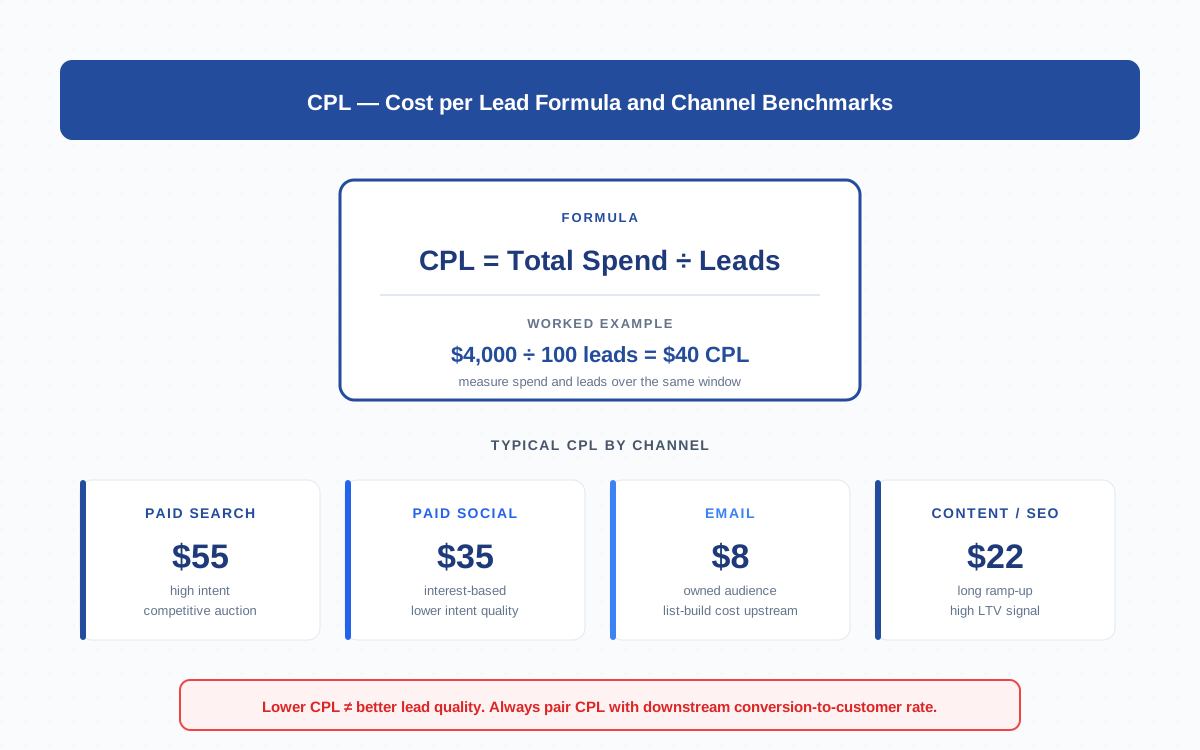
The metric bridges marketing budgets and the sales pipeline. Alone, CPL only says how cheaply you can fill the top of the funnel. Paired with lead-to-MQL, MQL-to-SQL, and close rate, it answers the harder question: how much pipeline does each marketing dollar actually produce?
The CPL Formula and a Worked Example
The arithmetic is the simplest part of the metric:
CPL = Total Campaign Spend ÷ Number of LeadsA worked example. You spent $4,000 on a LinkedIn lead-gen campaign over 30 days and recorded 100 form submissions. CPL is $4000 / 100 = $40. That number is meaningful only when measured against the same window’s spend, and only when “lead” is consistently defined across the period.
The trap most teams fall into: spend covers media only, while true CPL should also account for landing-page production, lead-magnet creation, and tooling. Strict media CPL is fine for in-flight optimization; blended CPL (media + production + tooling) is what your CFO needs for budget planning.
CPL vs CPA vs CPC — The Differences
CPL, CPA, and CPC are often used interchangeably in casual conversation, and that confusion costs money. They measure different funnel stages, and choosing the wrong one as your optimization target distorts campaign behavior.
| Metric | Formula | Counts | Best for | Risk if used wrong |
|---|---|---|---|---|
| CPL | spend ÷ leads |
Form fills, demo requests, gated downloads | B2B, SaaS, long sales cycles | Optimizing for volume of low-quality leads |
| CPA | spend ÷ acquisitions |
Customers, paid signups, completed purchases | E-commerce, performance marketing | Hard to optimize when conversion volume is below ~30/week |
| CPC | spend ÷ clicks |
Ad clicks, regardless of outcome | Bid management on search keywords | Cheap clicks that never convert |
Mental model: CPC is upstream of CPL, and CPL is upstream of CPA. A B2B SaaS funnel might show $3 CPC → $40 CPL → $400 CPA. Each step is a 10× multiplier reflecting drop-off between clicks, leads, and closed customers. When any ratio drifts, you know which funnel stage broke. For deeper comparison with CPM, see the CPA glossary entry.
What Counts as a “Lead”?
This is where most CPL reporting quietly falls apart. “Lead” is not defined by Google or by GA4 — it is whatever your team agrees to count. The four common definitions:
- Contact form submit — the broadest. Includes job applicants, vendors, support requests, and tire-kickers. Cheap to track; expensive to qualify.
- Demo or sales-call request — narrower and more valuable. The user has explicitly asked to talk to sales.
- Gated content download — whitepaper, e-book, calculator. Mid-funnel intent; usually requires nurture before sales sees it.
- Free trial or freemium signup — product-qualified lead (PQL) when the user actually activates inside the product.
The single most useful exercise: write a one-sentence definition of “lead” at the top of every campaign brief. Without it, CPL drops 40% next quarter and you discover the team quietly started counting newsletter signups. Treat lead-definition discipline as a macro conversion question — not all micro-conversions deserve the title.
Setting Up Lead Tracking in GA4
GA4 does not ship a “Leads” report. You build one by marking lead-related events as Key Events (formerly called Conversions in GA4 pre-2024 nomenclature):
- Decide your lead event(s). Common choices:
generate_lead(Google’s recommended event),form_submit(auto-collected via Enhanced Measurement), or a custom event likedemo_requestfor higher-intent forms. - Implement the event. Either via GTM (custom HTML or form-submit trigger), GA4 Enhanced Measurement (auto-tracks form submissions), or a server-side event push from your CRM webhook.
- Mark as a Key Event. Admin → Events → toggle “Mark as key event” on each lead event you want counted in acquisition reports.
- Tag every paid channel with UTMs. Without consistent UTM parameters, GA4 can’t separate paid vs organic leads, and CPL becomes uncomputable for non-Google channels.
- Link Google Ads. Admin → Product Links → Google Ads. This auto-imports cost data for Google campaigns, and the GA4 metric “Cost per conversion” (the GA4 alias for CPA/CPL) populates automatically.
Google’s guide to setting up key events covers the UI walk-through and the generate_lead recommended event in detail.
CPL in B2B vs B2C Contexts
“Good” CPL depends entirely on industry, deal size, and lead quality. Public benchmarks from HubSpot’s marketing benchmarks and First Page Sage’s annual reports give rough 2025 ranges:
| Industry / Model | Typical CPL Range | Notes |
|---|---|---|
| B2C e-commerce (newsletter, account) | $3 – $15 | Often a step toward a purchase, not the goal itself |
| B2C lead-gen (insurance, financial) | $30 – $120 | Highly regulated verticals push CPL up |
| B2B SaaS (mid-market) | $50 – $250 | Demo requests vs free-trial signups vary 3-5× |
| B2B Enterprise / Tech | $300 – $1,000+ | SQL-quality lead, often with company-size targeting |
| Healthcare, Legal, Higher Ed | $100 – $500 | Premium auctions; long buyer-research cycles |
The rule of thumb: CPL should be no more than ~10–20% of the closed deal’s gross margin contribution. A $200 CPL on a $20,000 ACV SaaS deal with 80% gross margin is healthy. The same $200 CPL on a $500 one-off product purchase is a slow-motion bankruptcy.
CPL by Channel — Paid Search, Paid Social, Email, Content
Channels produce wildly different CPLs because the underlying intent and audience differ:
- Paid search. Highest intent. CPL is high ($30–$150 for B2B) because commercial keyword auctions are expensive, but lead quality is best.
- Paid social (Meta, LinkedIn, TikTok). Interest-based, lower intent. LinkedIn $60–$200; Meta $15–$70 but with weaker lead-to-customer conversion.
- Email (owned list). Cheapest reported CPL ($3–$15) — but list-build and maintenance costs are rarely included. Blended email CPL is much higher.
- Content / SEO. Long ramp-up. Marginal CPL once ranking is near zero; amortized true CPL is $15–$50 over 24 months.
- Affiliate. Pay-per-lead deals look cheap on paper; vetting quality is critical (see affiliate marketing).
The cross-channel comparison only works when attribution is consistent. GA4’s default attribution model is data-driven, which can make last-touch CPL look artificially better than reality for top-funnel channels.
Calculating CPL in GA4 + Looker Studio
GA4’s standard reports surface “Cost per conversion” in Acquisition once Google Ads is linked. For non-Google channels:
- Import cost via Data Import. Admin → Data Import → Cost Data. Upload CSV with
date, source, medium, campaign, cost, clicks, impressions. Schedule weekly via SFTP or Sheets connector. - Build a Looker Studio report. Connect GA4. Add calculated field
CPL = SUM(advertising_cost) / SUM(generate_lead). Pivot by Source/Medium for channel breakdown. - Add date-range control with previous-period comparison. Week-over-week CPL drift is more actionable than absolute CPL.
- Filter spam and bot leads. Exclude sessions with generic referrers or use reCAPTCHA before counting
generate_lead. Otherwise CPL looks great while sales chases ghosts.
For higher-volume operations, BigQuery is the better home.
CPL in BigQuery — Cost Data Joined with Lead Events
The GA4 BigQuery export gives raw event-level data. Joining it with cost data unlocks per-keyword, per-creative, and per-cohort CPL analysis impossible in the GA4 UI:
WITH leads AS (
  SELECT
    event_date,
    (SELECT value.string_value FROM UNNEST(event_params) WHERE key = 'source') AS source,
    (SELECT value.string_value FROM UNNEST(event_params) WHERE key = 'medium') AS medium,
    (SELECT value.string_value FROM UNNEST(event_params) WHERE key = 'campaign') AS campaign,
    COUNT(*) AS lead_count
  FROM `project.analytics_XXXXXX.events_*`
  WHERE event_name = 'generate_lead'
    AND _TABLE_SUFFIX BETWEEN '20260101' AND '20260131'
  GROUP BY 1, 2, 3, 4
),
costs AS (
  SELECT date, source, medium, campaign, SUM(cost) AS spend
  FROM `project.cost_data.daily_spend`
  WHERE date BETWEEN '2026-01-01' AND '2026-01-31'
  GROUP BY 1, 2, 3, 4
)
SELECT
  c.source, c.medium, c.campaign,
  c.spend, l.lead_count,
  SAFE_DIVIDE(c.spend, l.lead_count) AS cpl
FROM costs c
LEFT JOIN leads l USING (source, medium, campaign)
ORDER BY cpl DESC;
This pattern scales to multi-touch attribution by joining lead events to the user’s full session history via user_pseudo_id. For pipeline-aware CPL — weighted by deal close rate — pull CRM data into the same warehouse and join on email or anonymous ID.
Lead Quality vs Lead Volume — Why Low CPL Isn’t Always Good
The most expensive mistake in CPL optimization is treating it as a number to minimize. If marketing’s bonus is tied to “lower CPL by 20%”, the easiest path is loosening the lead definition: count newsletter signups, count chatbot interactions, count contact-page visitors. CPL drops; sales pipeline stays flat; the next quarter shows a 60% rise in unqualified leads and a sales team that has stopped trusting marketing.
The defensive metrics every CPL dashboard needs alongside the headline number:
- Lead-to-MQL rate. What share pass marketing-qualified gates? Drops here while CPL drops = you’re buying junk.
- MQL-to-SQL rate. The honest test of whether marketing leads convert.
- Cost per SQL or Cost per Customer. The blended metrics that prevent CPL from being gamed.
The slogan that works: “Don’t optimize CPL — optimize the cheapest path to a customer.” Often that means accepting higher CPL on channels with better-qualified pipeline, and cutting low-CPL channels that look great in the slide deck but never close.
Optimizing CPL — Landing Page CRO, Targeting, Offer Testing
Once your lead definition is honest and tracking is clean, the levers for reducing CPL are well-understood:
- Landing page CRO. Doubling LP conversion rate halves CPL at the same spend. Test headline-to-ad relevance, form length (each extra field cuts conversion ~5%), and primary CTA visibility.
- Audience targeting refinement. Exclude bottom-quartile demographics, devices, and placements every 14 days. In Meta, use lookalikes off your closed-customer CRM list, not off all leads.
- Offer testing. The lead magnet matters more than the ad creative. “ROI calculator” vs “benchmark report” vs “30-day trial” often shows 3-5× CPL spread on the same audience.
- Negative keywords. A search campaign without monthly negative-keyword pruning silently leaks 20-40% of budget to irrelevant queries.
- Optimize for downstream value, not lead count. Use offline conversion imports to feed CRM stage data back into the bid algorithm — Google Ads bids on real pipeline, not noise.
Compound effect: a 30% LP improvement plus a 20% targeting refinement plus a higher-converting offer often produce 2-3× CPL improvement together — without changing ad creative.
Bottom Line
CPL is the cleanest single number for top-of-funnel paid efficiency — but only when the lead definition is locked, tracking is honest, and downstream pipeline metrics sit next to it. Treat CPL alone as a goal and the funnel devolves into volume games; treat it as one input alongside cost per SQL and customer LTV, and it becomes a precision tool for cross-channel budget allocation.
Frequently Asked Questions
What is CPL in marketing?
CPL stands for Cost per Lead. It is the average paid-media cost of producing one lead — typically a form submission, demo request, gated download, or trial signup. The formula is total spend divided by number of leads over the same period.
What is the difference between CPL and CPA?
CPL counts leads (top-of-funnel events like form fills or demo requests). CPA counts acquisitions (customers, completed purchases, paid signups). Same arithmetic, different denominator. CPL is upstream; CPA is downstream. A typical B2B funnel sees CPL of $40 and CPA of $400 — a 10× multiplier reflecting the lead-to-customer conversion rate.
What is a good CPL for B2B?
Mid-market B2B SaaS typically targets $50–$250 per lead, with enterprise reaching $300–$1,000+ for SQL-quality leads. The metric only makes sense alongside deal size — a $200 CPL on a $20,000 ACV deal with 80% gross margin is healthy, while the same CPL on a $500 product is unsustainable.
How do I track CPL in GA4?
Mark your lead event (typically generate_lead, form_submit, or a custom event) as a Key Event in Admin → Events. Link Google Ads to GA4 to import cost automatically. For non-Google paid channels, set up Data Import for cost data and tag campaigns with consistent UTMs. View “Cost per conversion” in Acquisition reports — that is GA4’s name for CPL.
What counts as a lead?
Whatever your team defines and consistently tracks. The four common definitions: contact form submission (broadest), demo or sales-call request (narrower, higher intent), gated content download (mid-funnel), and free trial or freemium signup (product-qualified). Lock the definition in writing before launching any CPL-targeted campaign — otherwise teams quietly broaden it to make the number look better.
Why is low CPL not always good?
Low CPL can mean efficient marketing — or it can mean you’ve loosened the lead definition to count low-quality signups. Always pair CPL with lead-to-MQL rate, MQL-to-SQL rate, and ultimately cost per customer. If CPL drops 30% but SQL conversion drops 50%, you’ve made things worse, not better.
What is the typical CPL by channel?
Rough 2025 directional ranges: paid search $30–$150 (high intent), paid social $15–$200 depending on platform (LinkedIn highest, Meta lowest), email $3–$15 (excludes list-build cost), content/SEO $15–$50 amortized over 24 months. Email looks cheapest on paper but rarely includes the upstream cost of building the list.
Related Terms
- CPA (Cost per Acquisition) — the customer-acquisition counterpart of CPL
- Conversion — the umbrella term for any tracked outcome
- Macro conversion — what qualifies as the headline outcome
- Micro-conversion — softer signals that often precede a lead
- Event — the GA4 primitive for capturing leads
- Attribution — the model that assigns credit across channels
- UTM parameters — required for multi-channel CPL reporting
- Affiliate — pay-per-lead deal structures
- CTR — upstream signal for ad relevance and CPL trajectory