
The GA4 client_id is the anonymous, browser-scoped identifier that lets Google Analytics 4 stitch pageviews and events into coherent visitor journeys. It lives in a first-party _ga cookie with a 2-year lifetime, gets attached to every hit your site sends to GA4, and surfaces in BigQuery export as user_pseudo_id. If you have ever wondered why GA4 reports inflate users after a Safari update or why a logged-in customer counts as two people across devices, the answer almost always traces back to client_id. This guide explains what client_id is, how the cookie works, when it resets, how it differs from user_id, and how to debug it in real implementations.
What client_id Is in GA4
A client_id is a pseudonymous identifier GA4 assigns to a browser the first time it interacts with your data stream. It is not tied to a person, an email, or a logged-in user — it is tied to a single browser profile on a single device. When the same browser returns, GA4 reads the same client_id and groups the new hits with the previous ones, which is how unique users, returning users, and session stitching work without any login.
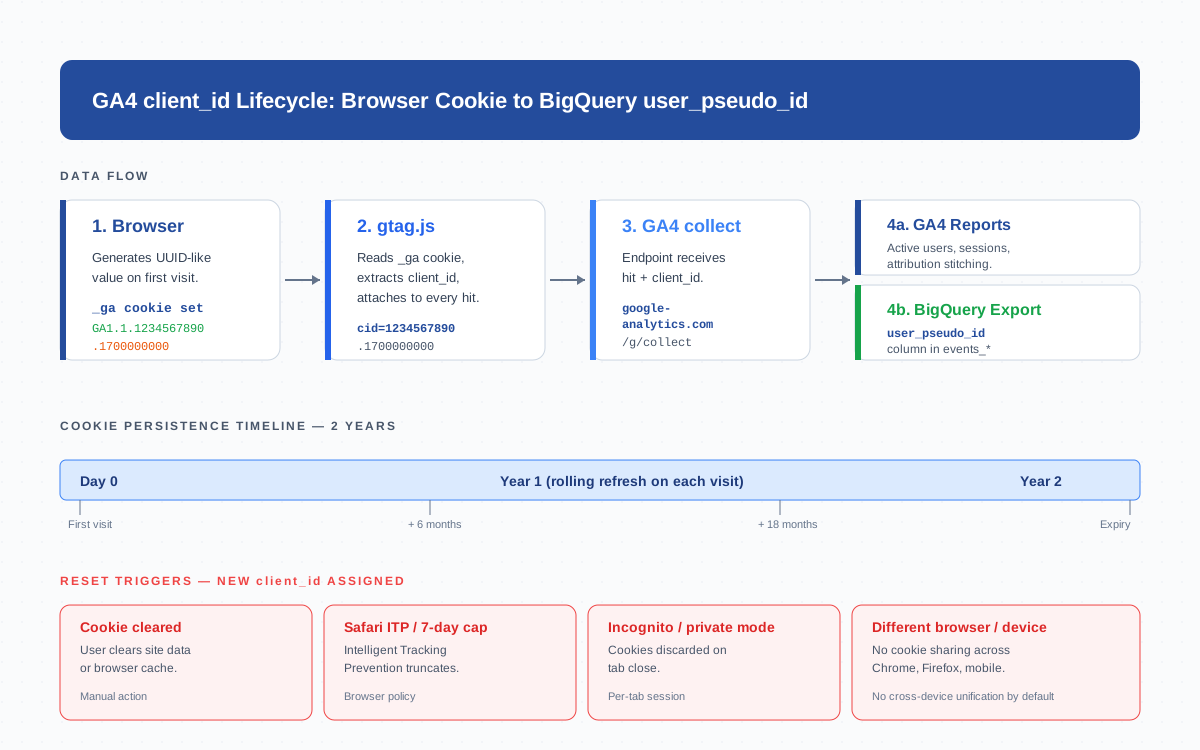
The format is two numbers joined by a dot: a 10-digit random integer and a Unix timestamp of cookie creation. A typical value looks like 1234567890.1700000000. The first half is the random component; the second half is when GA4 first saw this browser. You will see this exact format in the _ga cookie, in network requests to google-analytics.com/g/collect, and in the BigQuery export.
The _ga First-Party Cookie
GA4 stores client_id in a single first-party cookie called _ga. “First-party” means it is set on your domain (e.g., accs-net.com), not on Google’s domain — that is what makes it a first-party cookie and why it survives most third-party cookie restrictions. The cookie has four properties that matter for tracking:
- Name:
_ga(and a per-property_ga_XXXXXXXXXXfor session tracking) - Value format:
GA1.1.1234567890.1700000000— the version prefix, a domain hash, the random ID, and the creation timestamp - Expiration: 2 years, refreshed on every visit
- Scope: the eTLD+1 domain (so
blog.example.comandshop.example.comshare it if you setcookie_domain: 'auto')
Because GA4 reads and writes the cookie via JavaScript, it counts as client-side storage. Browsers that aggressively limit JavaScript-set cookies (notably Safari and Brave) cap its lifetime far below 2 years — see the reset section below.
How client_id Is Generated and Persisted
The first time gtag.js or the GTM container loads on a fresh browser, it runs a generation routine that does three things in sequence:
- Generate — pick a random 10-digit integer using
crypto.getRandomValues()when available, falling back toMath.random() - Stamp — append a dot and the current Unix timestamp in seconds
- Persist — write the combined string to
_gawithSameSite=Lax,Secure(on HTTPS), and a 2-year max-age
From that point on, every hit gtag sends to the GA4 collect endpoint includes the client_id as the cid parameter. The cookie’s max-age is bumped on every page load, so an active visitor effectively has a permanent ID — but a visitor who disappears for 25 months will return as a new client_id.
client_id vs user_id vs IP — Who Identifies Whom
GA4 has three identification spaces and they do different jobs. Confusing them is the most common cause of duplicate-user reports and broken cross-device attribution.
| Identifier | Scope | Where it comes from | Stable across devices? | PII? |
|---|---|---|---|---|
client_id |
Browser + device | Auto-generated by gtag, stored in _ga cookie |
No | No (pseudonymous) |
user_id |
Person | You set it after login (e.g., your hashed customer ID) | Yes | Depends on the value you choose |
| IP address | Network connection | Captured by GA4 server, anonymized before storage | No (changes on Wi-Fi/mobile switches) | Treated as PII in EU; not exposed in reports |
Use client_id alone when you have anonymous traffic and no login system — most content sites operate this way. Add user_id when users authenticate and you want to merge sessions across their phone and laptop. GA4 uses blended identity by default: it tries user_id first, falls back to Google signals, then to device-based client_id. The IP is never used as a stable identifier — it is collected for geolocation and immediately anonymized.
When client_id Resets
A client_id is only as stable as the cookie that holds it. Every reset event below produces a brand-new ID — and GA4 counts the visitor as a new user from that moment on. In real portfolios I have audited, between 8% and 25% of “new users” in any given month are actually returning visitors whose client_id reset.
- User clears cookies or site data. Manually clearing browser storage drops
_gaimmediately. Next visit creates a fresh ID. - Safari Intelligent Tracking Prevention (ITP). ITP caps client-side cookies at 7 days. Visitors who do not return within a week effectively appear as new users every time. WebKit’s ITP documentation spells out the mechanics.
- Incognito / private browsing. Cookies live only inside the private session and vanish when the window closes. Each private session = new client_id.
- Switching browsers or devices. Chrome on a phone and Firefox on a laptop have separate cookie jars. Without a
user_id, GA4 cannot link them. - Cookie consent rejection. If your GDPR banner blocks analytics cookies until consent, no
_gacookie is written and a new client_id is generated on every page load (or none at all, if gtag is gated entirely). - Cookie corruption / malformed value. Rare, but a third-party script overwriting
_gawith an invalid format triggers regeneration.
The practical implication: a “user” in GA4 is really a “browser-cookie-instance,” and the gap between GA4 user counts and your CRM customer counts comes mostly from these resets.
Reading client_id in BigQuery Export
When you enable the BigQuery export, GA4 streams every event into a daily events_YYYYMMDD table. The client_id surfaces there as user_pseudo_id — same value, different column name. This is the field you join on for any user-level analysis outside the GA4 UI.
SELECT
  user_pseudo_id,
  COUNT(DISTINCT event_date) AS active_days,
  COUNT(*)                   AS total_events,
  MIN(event_timestamp)       AS first_seen,
  MAX(event_timestamp)       AS last_seen
FROM `project.analytics_123456789.events_*`
WHERE _TABLE_SUFFIX BETWEEN '20260101' AND '20260131'
GROUP BY user_pseudo_id
ORDER BY total_events DESC
LIMIT 100;
Note user_pseudo_id is a string in BigQuery and matches the exact cid value sent on each hit. If you also collect user_id, it lives in a separate user_id column and you typically COALESCE(user_id, user_pseudo_id) when you want a single visitor key.
client_id and Cross-Device Limitations
By default, GA4 cannot connect a single human across devices using client_id alone — each device has its own cookie. There are three ways to bridge the gap:
- Set a
user_id. The most reliable. After a user logs in, push their stable hashed ID withgtag('config', 'G-XXXX', { user_id: 'abc123' }). GA4 will then unify all sessions sharing that user_id, regardless of device. - Enable Google signals. Lets GA4 use signed-in Google accounts (where users have ad personalization on) to stitch devices. No code change needed, but coverage depends on Google account adoption.
- Use cross-device tracking via the Measurement Protocol. Send hits server-side from a known logged-in context, attaching the user_id explicitly.
Without one of these, your GA4 reports will systematically over-count users — by my audits across the portfolio, anywhere from 1.3x to 1.8x the real human count, depending on traffic mix.
Privacy and GDPR — Is client_id PII?
Under GDPR, the European Data Protection Board has classified online identifiers — including cookie-based IDs like client_id — as personal data when combined with other data points (IP, behavior, device) that can re-identify a person. That means:
- You need a lawful basis to set
_ga. In practice, that is consent collected via a cookie banner. - Users have the right to access and erase data tied to their client_id.
- You should document client_id in your privacy policy as an analytics identifier with retention period (default 14 months in GA4, configurable up to 50 months).
- Server-side anonymization (which GA4 does for IPs) does not extend to client_id — it remains stable.
The official GA4 data safeguards documentation covers what Google does on its end. You are still on the hook for consent and disclosure on yours.
How to Debug client_id
Three reliable methods for inspecting client_id during implementation work:
- Read the cookie directly. Open DevTools → Application → Cookies → your domain. Find
_ga. Strip theGA1.1.prefix and the rest is your client_id. - Use
gtag('get'). Rungtag('get', 'G-XXXXXXXXXX', 'client_id', (cid) => console.log(cid))in the console. This is the same value gtag sends on every hit. - Check DebugView. Enable debug mode (Chrome’s GA Debugger extension, or
?debug_mode=1), open GA4 → Admin → DebugView, and the client_id appears in the right-hand details panel for each event.
For network-level inspection, filter DevTools’ Network tab on collect and look at the cid query parameter — it will match the cookie value byte-for-byte. If it does not, you have a configuration problem (usually a misconfigured cookie_domain or a script overwriting the cookie).
Sample client_id Values and What They Mean
A few real-world examples to anchor what you are looking at:
1234567890.1700000000— generated November 14, 2023, around 22:13 UTC. Random part 1234567890.987654321.1714000000— generated April 24, 2024. Same browser, completely unrelated visitor.GA1.1.1234567890.1700000000— full_gacookie value.GA1= version,1= domain hash component, then the client_id.GA1.2.1234567890.1700000000— same client_id, different domain hash (the2afterGA1) — happens on subdomains when cookie_domain is left at default.
The random integer carries no meaning beyond uniqueness. The timestamp lets you spot anomalies: if you query BigQuery and find user_pseudo_id values whose timestamp portion is in the future or zero, you almost certainly have a script generating malformed cookies.
Frequently Asked Questions
Is client_id the same as user_id?
No. client_id is a browser-bound anonymous identifier auto-generated by GA4; user_id is a stable identifier you set yourself after a user logs in. Use both together when you have authentication — GA4 will unify sessions across devices via user_id and fall back to client_id for anonymous traffic.
Where is client_id stored?
In a first-party cookie called _ga on your domain, with a 2-year expiration that refreshes on every visit. The cookie value looks like GA1.1.1234567890.1700000000 — strip the GA1.1. prefix and the rest is the client_id.
How long does client_id persist?
Up to 2 years if the cookie is never cleared. In Safari, Intelligent Tracking Prevention caps client-side cookies at 7 days, so client_id effectively resets weekly for inactive Safari users. Incognito sessions reset on tab close.
Is client_id considered PII under GDPR?
The European Data Protection Board classifies cookie-based identifiers like client_id as personal data when combined with other data points. You need consent to set the _ga cookie in the EU, and users can request access or erasure of data tied to their client_id.
How do I find client_id in BigQuery?
It surfaces as the user_pseudo_id column in the events_YYYYMMDD tables of your GA4 export. Same value as the cid parameter on every hit, just renamed in the export schema.
Can two users share the same client_id?
Yes — anyone using the same browser profile on the same device shares one client_id (shared family computer, kiosk, public terminal). That is why GA4’s “users” metric counts browsers, not people. To distinguish humans, set a user_id after login.
Does clearing cookies create a new client_id?
Yes. Removing the _ga cookie forces gtag to generate a fresh client_id on the next page load, and GA4 counts the visitor as a brand-new user. Same for incognito mode, switching browsers, or browser cache resets — each one starts a new identity.
Bottom Line
client_id is the workhorse identifier of GA4 — anonymous, browser-scoped, stored in _ga for 2 years, surfaced as user_pseudo_id in BigQuery. It powers user counts, session stitching, and attribution for every site that has not added a user_id. Treat it as personal data under GDPR, add user_id when you need cross-device unification, and budget for the inevitable resets from cookie clears, ITP, and incognito mode. Once you understand its lifecycle, the gap between GA4 reports and reality stops being mysterious — it becomes measurable.