
Every analytics dashboard is crowded with numbers, and most of them don’t matter. Pageviews are up, sessions are up, your bounce rate dropped two points — and none of it tells you whether the business is actually doing better. The problem isn’t a lack of data; it’s a lack of the right data. Choosing the handful of KPIs that genuinely reflect progress is one of the highest-leverage decisions you’ll make in analytics. This guide shows you how to separate the metrics that drive decisions from the ones that just fill a report.
If you want a head start on the right metrics for your model, our KPI Dictionary maps common business types to the KPIs that fit them. But knowing why a metric earns KPI status is what keeps your dashboard honest.
KPI vs. Metric: They’re Not the Same
People use “KPI” and “metric” interchangeably, and that’s the root of most reporting clutter. They are not the same thing, and the difference is the whole point.
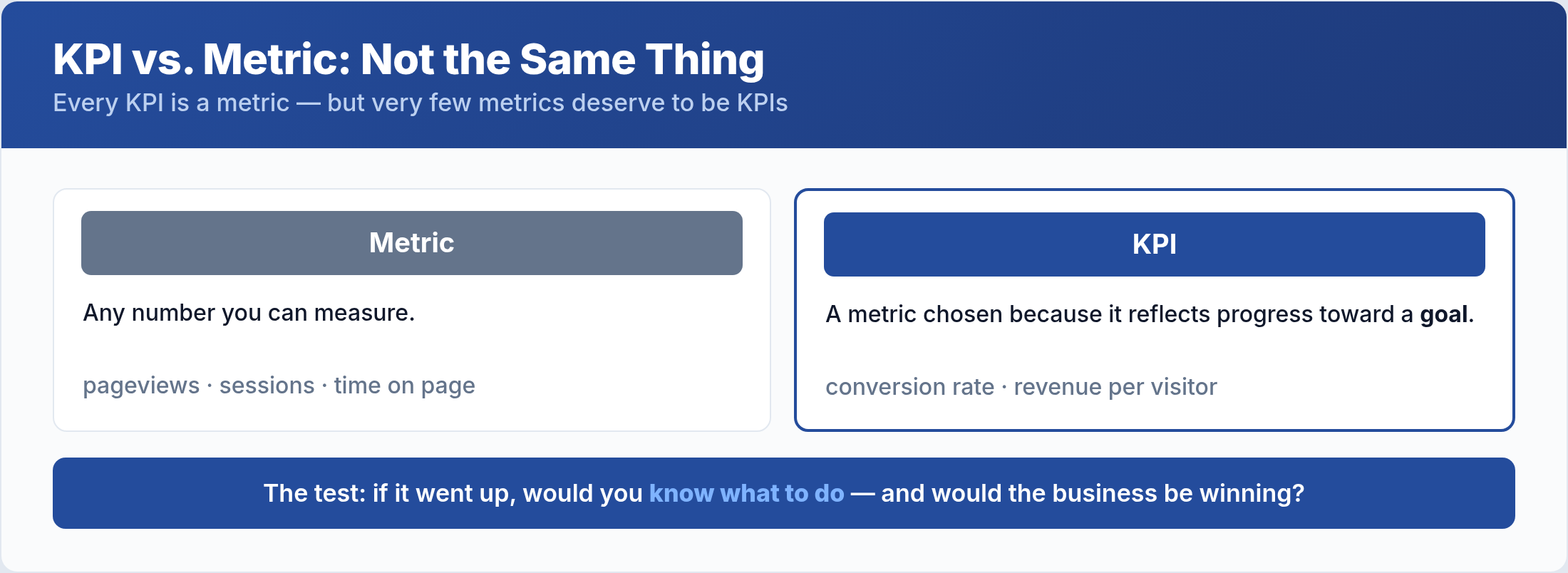
A metric is any number you can measure — pageviews, sessions, time on page. A KPI (key performance indicator) is a metric you’ve chosen because it directly reflects progress toward a goal. Every KPI is a metric, but very few metrics deserve to be KPIs. The test is simple: if the number went up, would you know what to do — and would it mean the business is winning? If not, it’s a metric, not a KPI.
Vanity Metrics vs. Actionable KPIs
The metrics that feel best to report are often the ones that mean the least. Vanity metrics go up and to the right, make everyone feel good, and change no decisions.
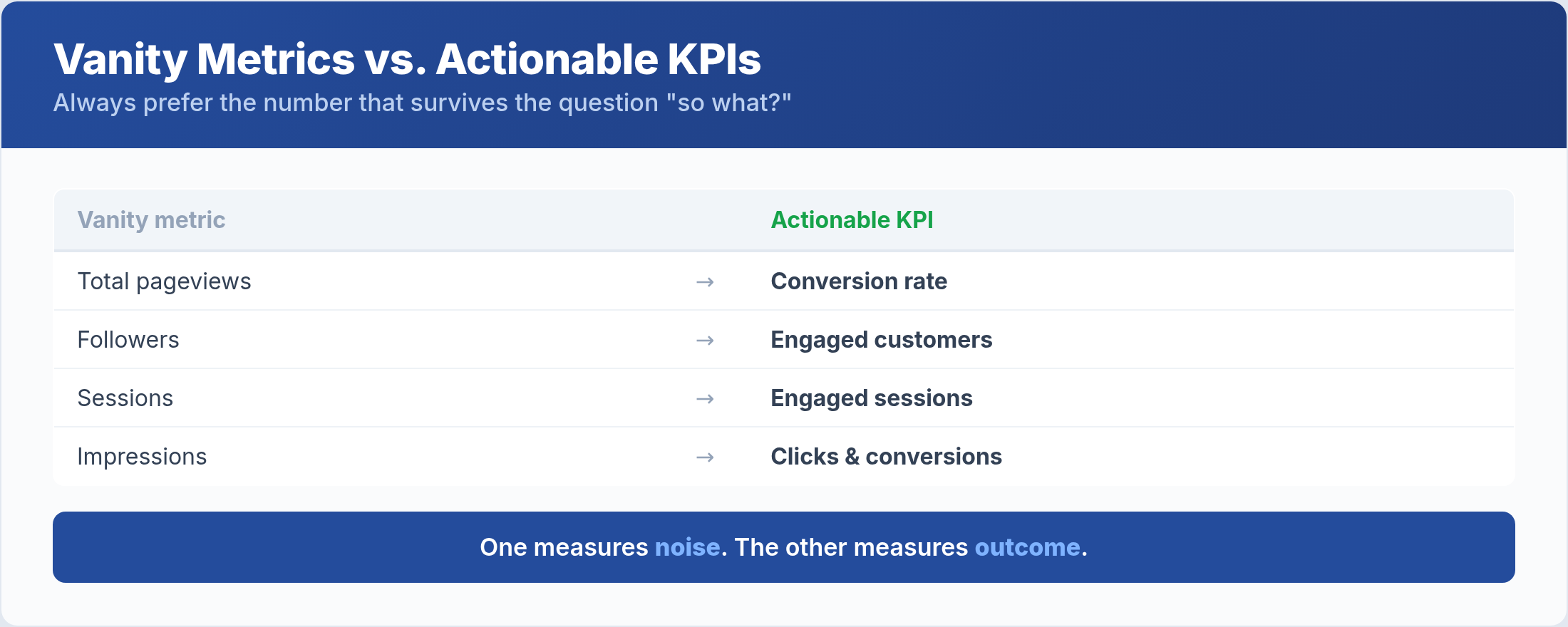
Total pageviews is the classic vanity metric: it rises with traffic quality and traffic junk alike, and a bigger number tells you nothing about whether visitors did anything valuable. Its actionable cousin is conversion rate — the share of visitors who took the action you care about. One measures noise; the other measures outcome. The pattern repeats everywhere: followers vs. engaged customers, sessions vs. engaged sessions, impressions vs. clicks. Always prefer the metric that survives the question “so what?”
The Three Tests of a Good KPI
Before you promote any metric to KPI status, run it through three checks. A number that passes all three earns a place on your dashboard; one that fails any should stay in the detail reports.
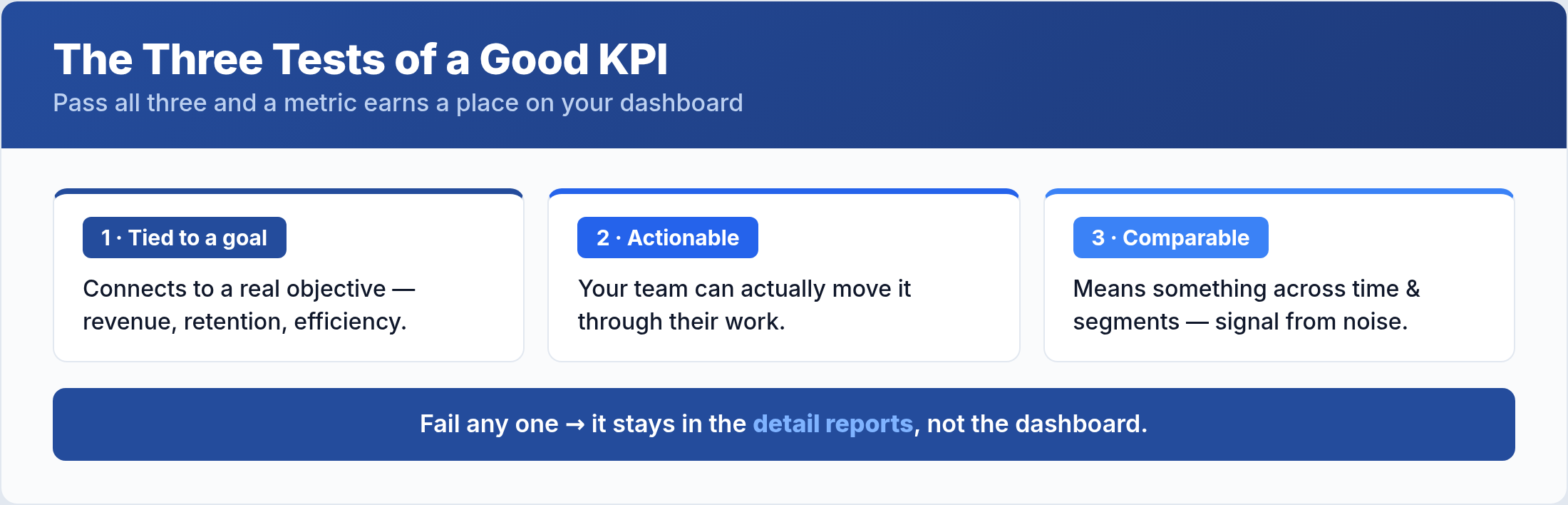
First, is it tied to a goal? A KPI must connect to a business objective — revenue, retention, efficiency. If you can’t name the goal it serves, it’s not a KPI. Second, is it actionable? Moving the number must be something your team can actually influence through their work; a metric nobody can affect is a scoreboard, not a lever. Third, is it comparable? A good KPI means something across time and segments, so you can tell improvement from noise. Pass all three and you have a real KPI.
KPIs by Business Type
There’s no universal KPI list, because the right KPIs depend entirely on how your business creates value. What matters for an e-commerce store is irrelevant to a content site.
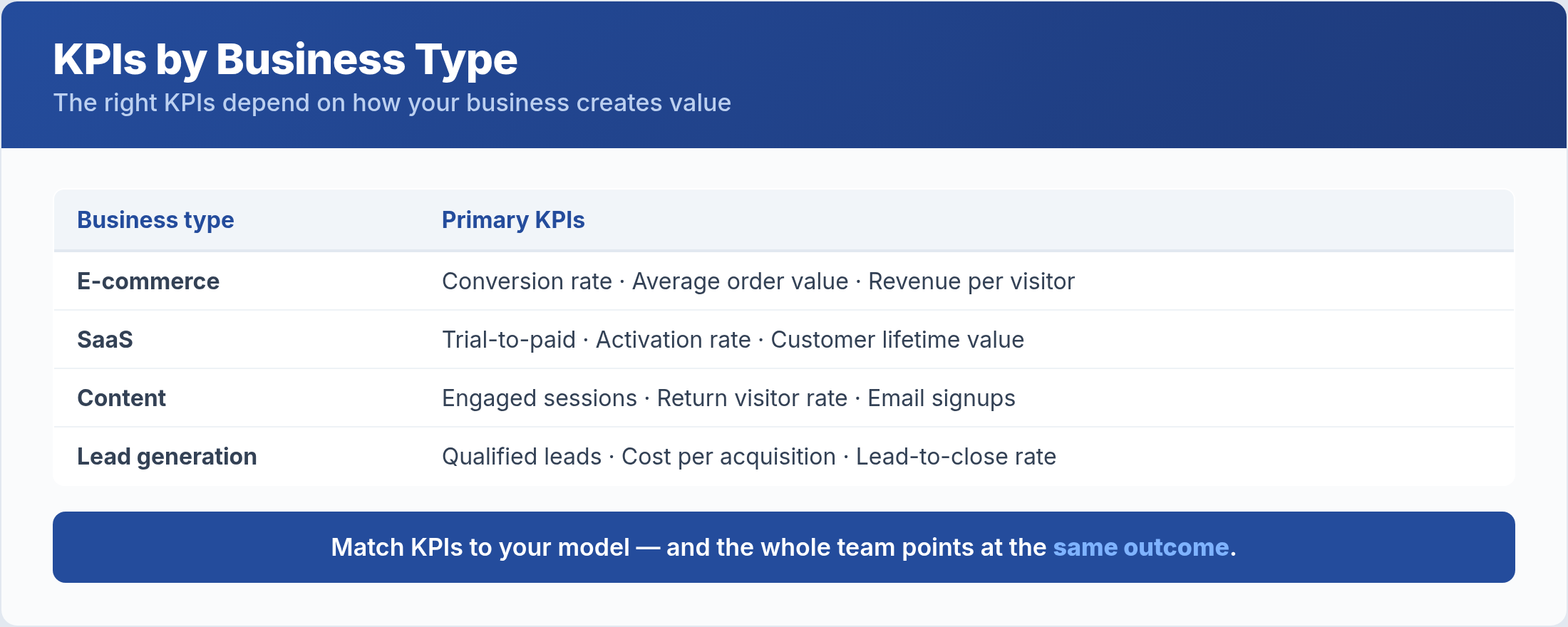
An e-commerce site lives or dies on conversion rate, average order value, and revenue per visitor. A SaaS product cares about trial-to-paid conversion, activation rate, and customer lifetime value. A content site watches engaged sessions, return visitor rate, and email signups. A lead-gen site tracks qualified leads and cost per acquisition. Match your KPIs to your model, and they’ll point the whole team at the same outcome instead of pulling in different directions.
Build a KPI Hierarchy, Not a Wall of Numbers
The mistake even careful teams make is treating all KPIs as equal. A good measurement system has a shape: one primary metric on top, supported by the inputs that drive it.
Put your single most important KPI — the one that best captures value created — at the top. Below it, place the input metrics that feed it: the smaller, more controllable numbers each team can move. Revenue sits on top; conversion rate, average order value, and traffic quality sit beneath as the levers. This hierarchy keeps everyone aligned on the one number that matters while giving each team a specific input they own. It’s the difference between a focused dashboard and a wall of numbers nobody acts on.
Common KPI Mistakes
Most KPI problems come from measuring what’s easy instead of what matters. Avoid these.
- Tracking too many KPIs. Twenty KPIs means none of them is key. Pick three to five that genuinely drive decisions.
- Choosing vanity metrics. If a number can rise while the business stays flat, it’s vanity. Demand a connection to outcomes.
- Ignoring context. A KPI with no benchmark or trend is just a number. Always compare against your own history or a target.
- Confusing a metric with a KPI. Not every number deserves dashboard space. Reserve KPIs for the metrics tied to goals.
- Never revisiting them. As the business changes, the right KPIs change. Review your set periodically instead of measuring the same things out of habit.
Frequently Asked Questions
How many KPIs should I track?
Fewer than you think — usually three to five at the top level. The goal of a KPI is focus, and a long list destroys it. Keep a small set of primary KPIs on your main dashboard and push everything else into supporting detail reports.
What’s the difference between a KPI and a metric?
A metric measures anything; a KPI is a metric chosen because it reflects progress toward a goal. Every KPI is a metric, but most metrics aren’t KPIs. The deciding question is whether the number connects to an objective and would change a decision.
Are pageviews ever a good KPI?
Rarely, and only when views are the value — like an ad-funded publisher paid per impression. For almost every other business, pageviews are a vanity metric, and engaged sessions or conversions tell you far more about whether anything valuable happened.
How do I know if a metric is “vanity”?
Ask whether it can go up while the business gets no healthier. If yes, it’s vanity. A true KPI can’t rise without something good actually happening — more revenue, more retention, more qualified leads. If the number and the outcome can move in opposite directions, leave it off the dashboard.
The Bottom Line
Good analytics isn’t about collecting more numbers — it’s about choosing the few that matter. A KPI is a metric tied to a goal, one your team can move and compare over time; everything else is detail. Reject vanity metrics that rise without the business improving, match your KPIs to how you actually create value, and arrange them in a hierarchy with one primary number supported by the inputs that drive it. Keep the list short, revisit it as you grow, and your dashboard will finally answer the only question that matters: are we winning?